God works in mysterious ways, not in linear math – Bridge Fan
I had a curious insight that could be relevant to UPGs, that is, Unreached People Groups.
TLDR: Tibet and Japan?
I have a personal habit, if I don’t get a quick clear decision from my conscience, or the Holy Spirit, of systematically problem solving. The following gives a little insight into what could’ve been a five minute search on fontspace.com, but turned into a huge chunk of my day.
Once I have a website to work with, my brain starts looking for inconsistencies. These tend to be bugs or at least hidden features. One humongous source of these is exposed with Unicode. I’ll define it as a glorious way of encoding, using what’s called a code point, a symbol into a computer system, which can then be visually displayed as a glyph. All this, so messages can be shared, same code point, from one device to another, and rendered with the end-user-preferred glyph (often the system or manufacturer default).
This blog post is one example, because before there was say Unicode 5.1, there were things like American Standard Code for Information Interchange (ASCII) which ultimately led to mojibake, which I first learnt through Nick Coghlan about a decade ago, but the ephemeral nature of the web means even that’s now hard enough to find I’ll abandon it for now, though here’s something similar. Naturally this was also known in for example Google’s Java Style Guide:
Tip: Never make your code less readable simply out of fear that some programs might not handle non-ASCII characters properly. If that should happen, those programs are broken and they must be fixed.
So if I want to share something from a beloved artist, דרור, that I happen to listen to, if both you and I haven’t at some level agreed to use Unicode, what I share is all but certain to appear to you as empty space or mojibake. That, combined with something I wrote on my studio whiteboard, led me to a primitive test on fontspace.com where I could search from right to left (last page to first, another fun thing about many written languages, the English left to right convention is as far as I know a completely arbitrary accident of history, another footnote is the WordPress editor – the blog writing backend I’m using for now, doesn’t let my cursor even be positioned between each character in the test text below, yet another bug):
test: שָׁלוֹם šālōm שָׁלוֹם דרור
I also noticed that the “Commercial-use” checkbox loses its checked state when I change to the next page, hopefully fontspace.com fixes that in the future, but I’ll be lazy and not report it right now (can you see I’m backlogged enough and forgive me?).
While searching, I found three fonts that rendered the test text completely, rather than with blank empty spaces, in a way I found meaningful.
One font was Japanese, designed for anime, which I can’t name because it’s forbidden in the license to use that font for religious reasons. This post absolutely contains religious components. So finding that font is left as an exercise to the super-curious reader.
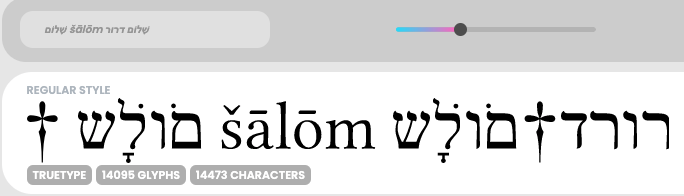
Both the Japanese font and the Tibetan font rendered 0x00A0, that is the non-breaking space character, as what I see as a cross, so I see Jesus. Here’s the Tibet one, Yagpo Tibetan Uni Font, designed by Open Source Buddhism Library (which I’ve applied a WordPress two-tone filter to, so hopefully there’s enough contrast to see it, as I don’t want to fill the transparent pixels in to make them white):

The third font I noticed rendered all the text meaningfully (to me) was naturally a debugging font, Unicode BMP Fallback SIL Font. Which at least gets the Basic Multilingual Plane:

But is this actually an example of two locations where people groups can be reached?
Or is it mystery Babylon?
Sometimes there are more questions than answers, Vishal Mangalwadi in The Book That Made Your World (2011) teaches us it’s been Bible-believers (and not the Buddhists or many other people groups) who accrued partial knowledge rather than seeking to empty their minds, and so I would summarise, literally transforming, through technology, science, music and so on, the world, to make it better for all humanity in our upward progression through A Thousand Generations.
P.S. I think as Yagpo Tibetan Uni Font is licensed GPL, that theoretically makes this post GPL, until Jesus comes to sort out all us lawmakers and lawbreakers (more generally I’ve thought Creative Commons in the past, but really it’s a sign not all of us would bother with taking a brother or sister to a court, the cost is almost always too high). And here’s a screenshot of another possible issue found when confirming the earlier finding about the non-breaking-space glyph, the words somehow get mixed around when rendered (but it might just be the limit of my brain’s understanding so far, there’s a lot in those specifications!):
P.P.S. It’s well known the internet is finite, because the universe is finite (or God’s not omnipresent!) but perhaps I could say something like searching it has no practical end within any given time-bound. So I could start a DuckDuckGo search for my beloved artist, find some article on a bird, and end up learning the first inkling about GND being machine-translated by Firefox as a “Common Standard File”. All this before I get to the “ick” where AI has surely become the new synergy, a meaningless buzzword that makes me want to career change. Maybe I will when I come out of my Sabbatical?
P.P.P.S. All I wanted earlier today was a font I probably wouldn’t get sued over. Maybe it’d be easier to find someone to pay for a font…or design my own? Perhaps not, other things need to get done too. It’s another example of The Law of Priorities, here’s Clay Green’s take.
Thank you for taking a journey with me today.
 Peter Johannes Schmidt